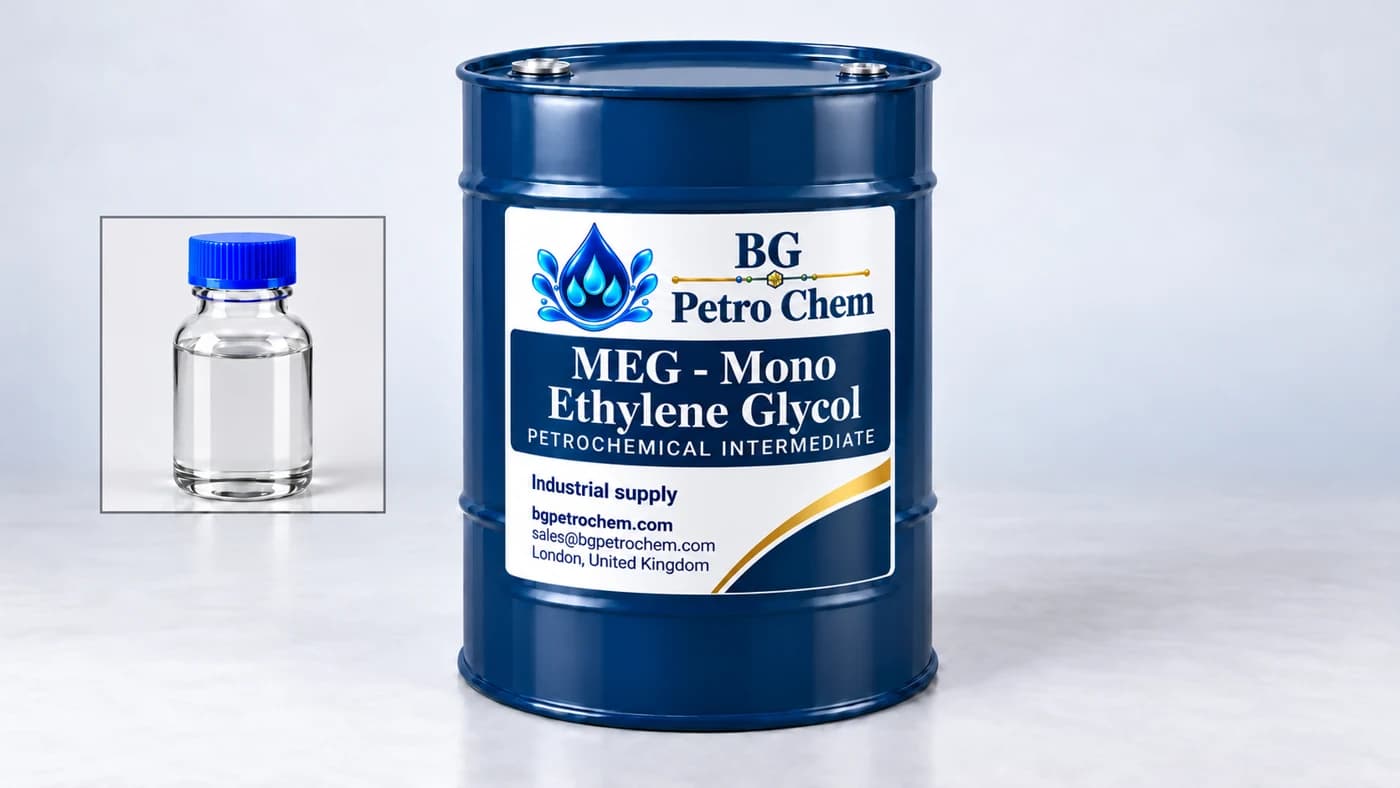
Illustrative packaging. Pack format confirmed with your quotation.
About This Product
Polyester takes far more mono ethylene glycol (MEG) than any other use. Reacted with purified terephthalic acid, it forms PET, the polymer made into textile fibre, film and bottles. Antifreeze and engine coolant form the second large outlet: a 50:50 mix with water gives protection to roughly −37 °C, and the same principle is applied in heat-transfer fluids for chillers, solar installations and process systems. MEG also goes into aircraft de-icing fluids and unsaturated polyester and alkyd resins, serves inks and adhesives as a humectant and freezing-point depressant, and is used in natural gas pipelines as a hydrate inhibitor.
Chemically it is ethane-1,2-diol (C2H6O2; CAS 107-21-1; EC 203-473-3), the simplest diol and among the highest-volume organic chemicals made. Production is by hydration of ethylene oxide or by the ethylene carbonate route. Diethylene and triethylene glycol arise as co-products, and that is why DEG content is one of the limits that define a grade. MEG is a clear, colourless, slightly viscous liquid that boils at about 197 °C, mixes with water in any proportion and absorbs moisture from the air.
The market splits into two qualities. Fibre grade, also known as polyester grade, is the high-purity glycol for PET production, and its limits are tight because traces of impurity show up in the polymer as yellowing and haze and lead to poor spinning. Typical fibre-grade values are purity 99.9% minimum, DEG 0.05% maximum, acidity (as acetic acid) 0.001% maximum, Pt-Co colour 5 maximum, or 20 maximum after heating with acid, and UV transmittance at 220 nm of 75% minimum; iron, ash, aldehydes and transmittance at 275 and 350 nm complete the list. Water is typically 0.08–0.10% maximum and density 1.1128–1.1138 g/cm³ at 20 °C. Industrial grade, sometimes sold as antifreeze grade, has wider limits and covers coolants, heat-transfer fluids and chemical processing where polymer purity is not required; purity, water, DEG and colour usually suffice to define it. Whatever the grade, agree the limits in writing and check each certificate of analysis against them.
Under CLP, MEG carries H302 (harmful if swallowed) and H373, for possible kidney damage from prolonged or repeated oral exposure. Its sweet taste makes accidental poisoning a real danger, so it must never be put into containers used for drinks. Road, sea and air transport rules do not treat it as dangerous goods, although section 14 of the safety data sheet should still be consulted. The substance is registered under EU REACH, and anyone importing into the EU or Great Britain should confirm which REACH or UK REACH registration applies to that import and use.
Since MEG picks up atmospheric moisture, tanks should be closed and made of stainless steel, aluminium or lined mild steel, with fibre grade kept under a dry nitrogen blanket and drums left sealed. Keep it apart from strong oxidisers and strong acids. It is combustible at elevated temperature, with a flash point of around 111 °C.
For a BG Petro Chemicals quotation, say whether you need fibre or industrial grade, the limits that matter (purity, DEG, water, UV transmittance), the pack (drum, IBC, flexitank or ISO tank), the volumes, the destination and the Incoterms.