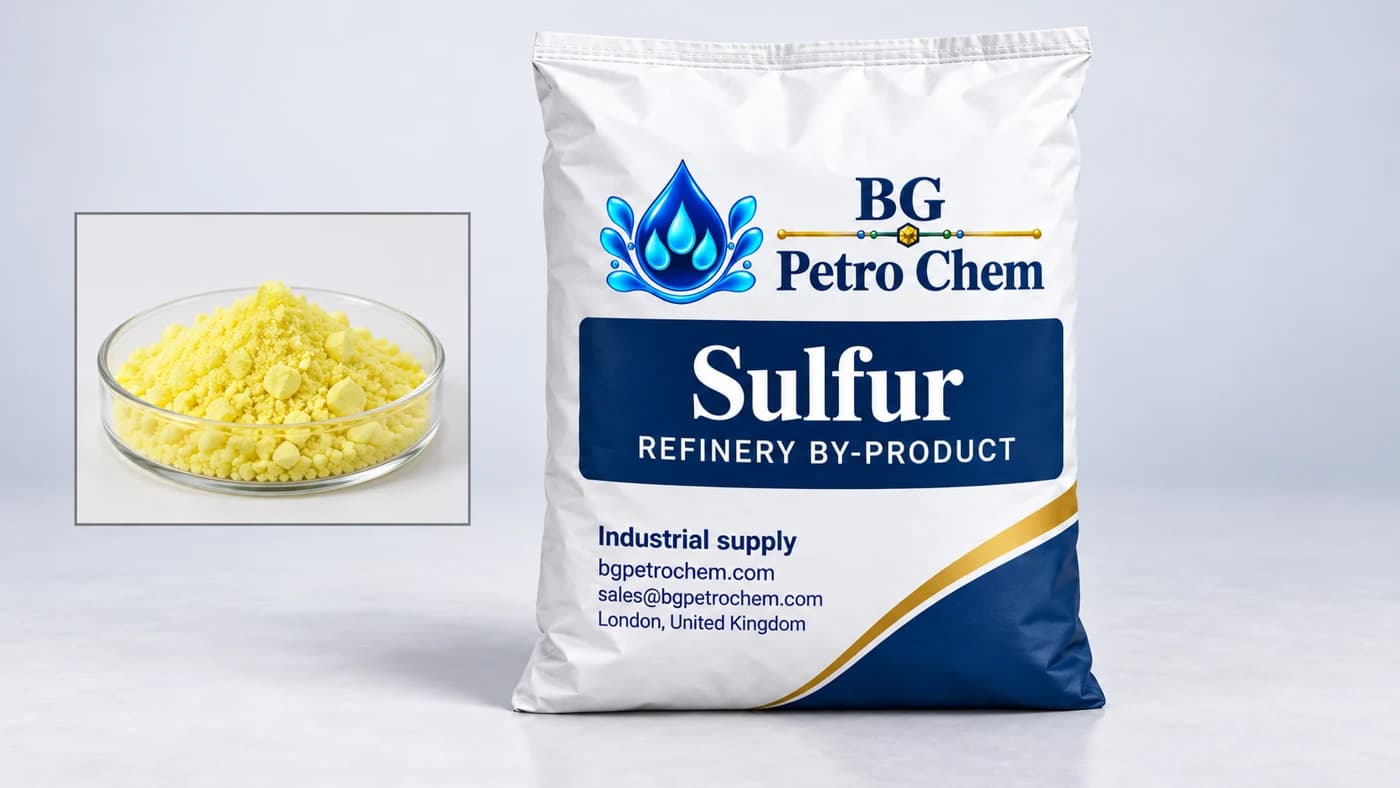
Illustrative packaging. Pack format confirmed with your quotation.
About This Product
Sulphur (elemental S, CAS 7704-34-9) is offered here as bright yellow granules or lumps recovered at refinery hydrodesulphurisation (HDS) and Claus units, with origin Pakistan. Nearly all sulphur on the market today is produced this way, as an involuntary by-product. Refiners and gas processors must strip sulphur compounds from fuels and natural gas to comply with emissions legislation, and the Claus process converts what they remove into the element.
Because output follows oil and gas throughput rather than sulphur demand, prices are unusually volatile. Roughly 85 percent of world supply is burned to sulphur dioxide and converted into sulphuric acid. That acid is the highest-tonnage manufactured chemical in the world, and most of it goes into phosphate fertiliser production. Many of the remaining uses rely on sulphur's ability to form chains and bridges between atoms. Rubber compounders use it as the vulcanising agent that builds sulphide crosslinks, turning a soft, plastic mass into an elastic solid. In agriculture it is a secondary plant nutrient and, in micronised wettable form, one of the oldest fungicides and acaricides still in use. It also finds outlets in bitumen modification and in leaching chemistry for mining.
The main markets are sulphuric acid manufacture, rubber vulcanisation, fertilisers and soil amendment, agricultural fungicides, mining chemicals and bitumen modification.
The current offer specifies a purity of 99.8 wt% minimum on a dry basis, moisture plus hydrocarbon of 0.13 wt% maximum, and ash plus organic matter of 0.06 wt% maximum, all by gravimetric method. Colour is bright yellow by visual inspection, and bulk density is reported rather than specified. Further limits on acidity, carbon, arsenic and particle size can be set in the agreed specification.