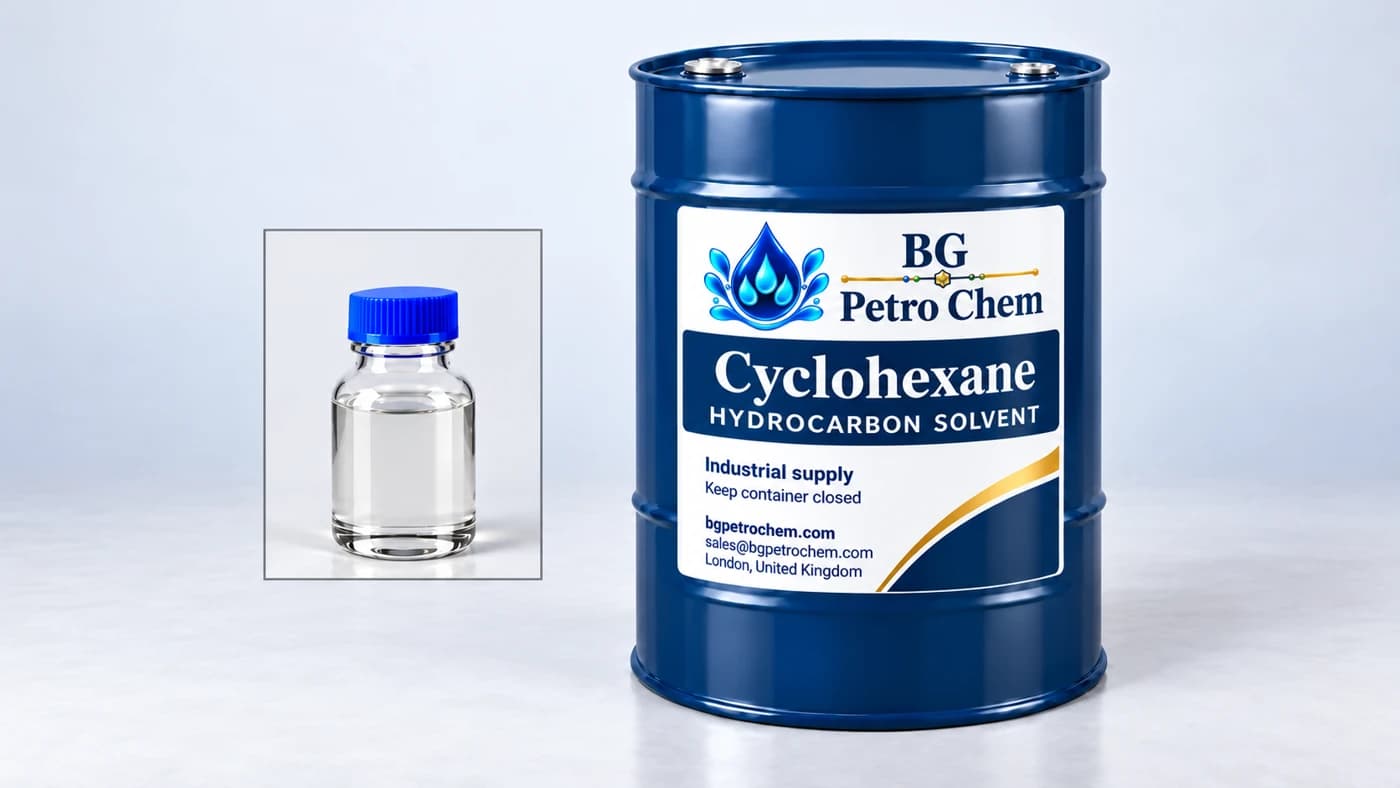
Illustrative packaging. Pack format confirmed with your quotation.
About This Product
Producers of nylon intermediates use cyclohexane as the first link in their chain. Oxidation turns it into KA oil, the blend of cyclohexanone and cyclohexanol from which adipic acid and caprolactam are made, and from those nylon 6,6 and nylon 6. As a non-aromatic solvent, the saturated six-membered ring (C6H12, CAS 110-82-7) dissolves resins, rubber, fats and paraffin oils, and it is used in paints and coatings and for recrystallisation and extraction.
Almost all commercial cyclohexane comes from hydrogenating benzene, so leftover benzene is the impurity that sets the quality. This grade holds it to 50 mg/kg maximum, with n-hexane no higher than 200 mg/kg, sulphur no higher than 1 mg/kg and a distillation range of 1 °C at most. Purity is 99.9 percent minimum, Pt-Co colour 10 max, non-volatile matter 1 mg/100 ml max and density 0.777–0.782 g/cm³ at 20 °C. The liquid is clear, colourless and mobile with a mild odour; it boils at 81 °C, does not mix with water and is miscible with most organic solvents.
Storage needs some thought, because cyclohexane freezes at 6.5 °C, a far higher temperature than most solvents. Drums kept outdoors and unheated lines can freeze solid in winter, and heated storage may be required.
BG Petro Chemicals supplies cyclohexane in 150 kg drums or ISO tanks under UN 1145, Class 3, PG II. It is highly flammable and an aspiration hazard; follow the safety data sheet. Current specifications, the SDS and available batch documentation can be provided on request.
Specifications
Applications
Packaging Options
- 150 kg drum
- ISO tank
Supply notes
- Product documentation
- Contact our team for current specifications, safety data and available batch documentation.