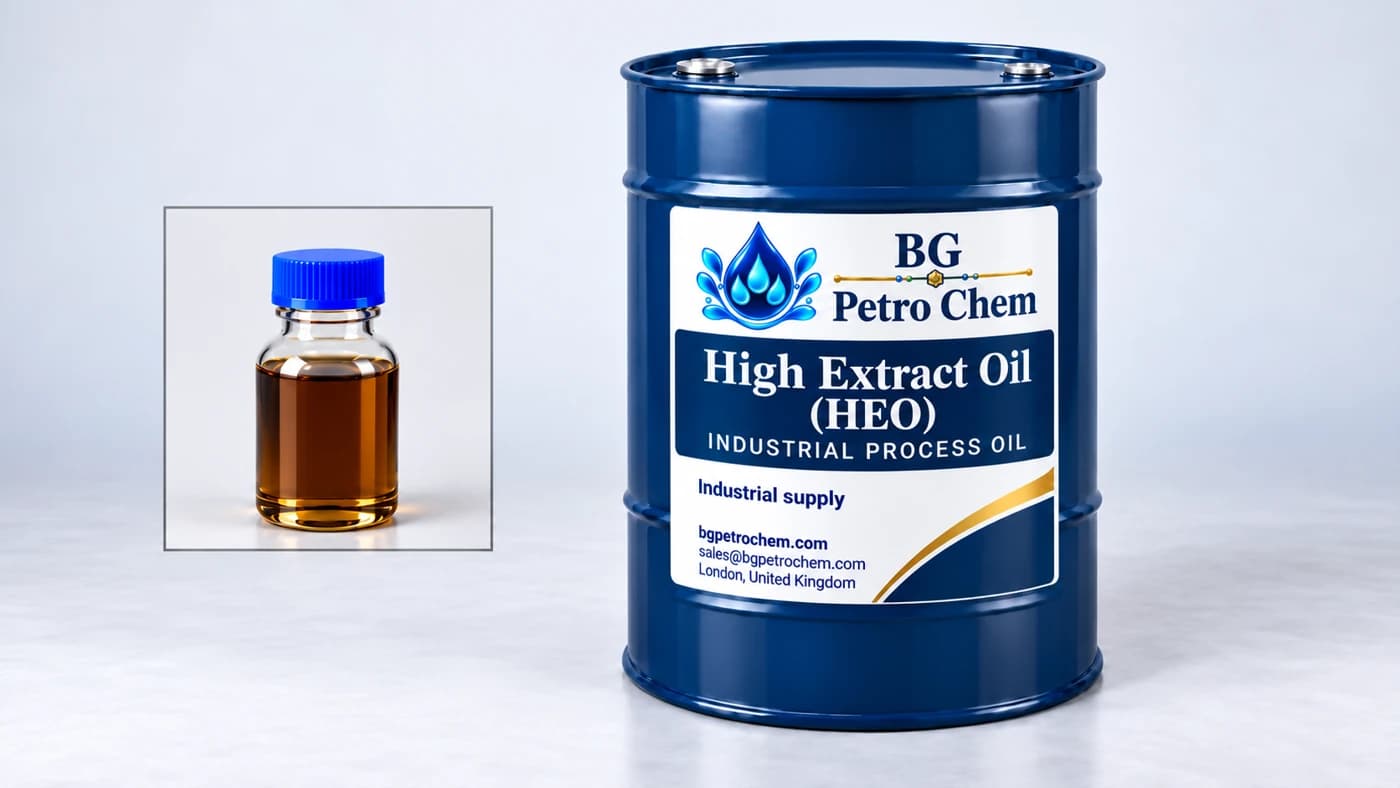
Illustrative packaging. Pack format confirmed with your quotation.
About This Product
Three kinds of buyer account for most High Extract Oil. Rubber compounders use it to extend SBR and natural rubber in tyres and general rubber goods; reclaimers rely on it to swell and peptise scrap tyre rubber during reclaiming; and bitumen producers blend it into hard grades to soften them. What all three want is high solvency in a dark, heavy oil.
Body is the point of difference. HEO must reach at least 12.0 cSt at 100 °C, and that floor is what divides it from the lighter Low Extract Oil. In the mixer the extra weight means less oil is lost to evaporation, in a cured article less of it works its way to the surface, and an oil-extended polymer can hold higher loadings of it. During reclaiming, viscosity and solvency together let it swell vulcanised crumb, after which heat and shear can take the cross-linked network apart.
Specific gravity is capped at 1.10 and sulphur at 5.6 wt %, Conradson carbon residue may not exceed 10.0 wt %, and the COC flash point is at least 150 °C. Buyers used to base oils may find the sulphur figure high, but it follows from how the oil is made, since extraction gathers the crude's sulphur-bearing aromatics into this stream. Carbon residue is a gauge of coke-forming material and becomes relevant when the oil is used hot, bitumen fluxing being one example. Expect a heavy liquid at ambient temperature that normally needs warming before it pumps freely.
HEO is a by-product of base oil manufacture. To give heavier lube distillates a good viscosity index, refiners wash them with a selective solvent, which dissolves out multi-ring aromatics together with sulphur compounds and polar species. Stripping off and recycling the solvent leaves this extract behind. It is the heavier and more aromatic of the range's two extract oils, Low Extract Oil being the other.
Rubber Process Oil, the tyre compounding grade, is defined by its VGC range and pour point, whereas HEO is defined by a viscosity floor plus sulphur and carbon residue limits. That is why HEO is usually preferred where solvency and volume outweigh the need for a narrowly defined compounding range. Monthly availability is indicated at 2,500 – 5,000 MT, and the hazard classification of this extract, with the handling it calls for, appears in the SDS.
BG Petro Chemicals supplies HEO of Pakistan origin in ISO tanks, IBC tanks or drums, with other packaging by agreement. Every lot is documented with a certificate of analysis, and the technical datasheet and SDS are available on request.
Specifications
Applications
Packaging Options
- Drums
- IBC tanks
- ISO tanks
- Custom packaging