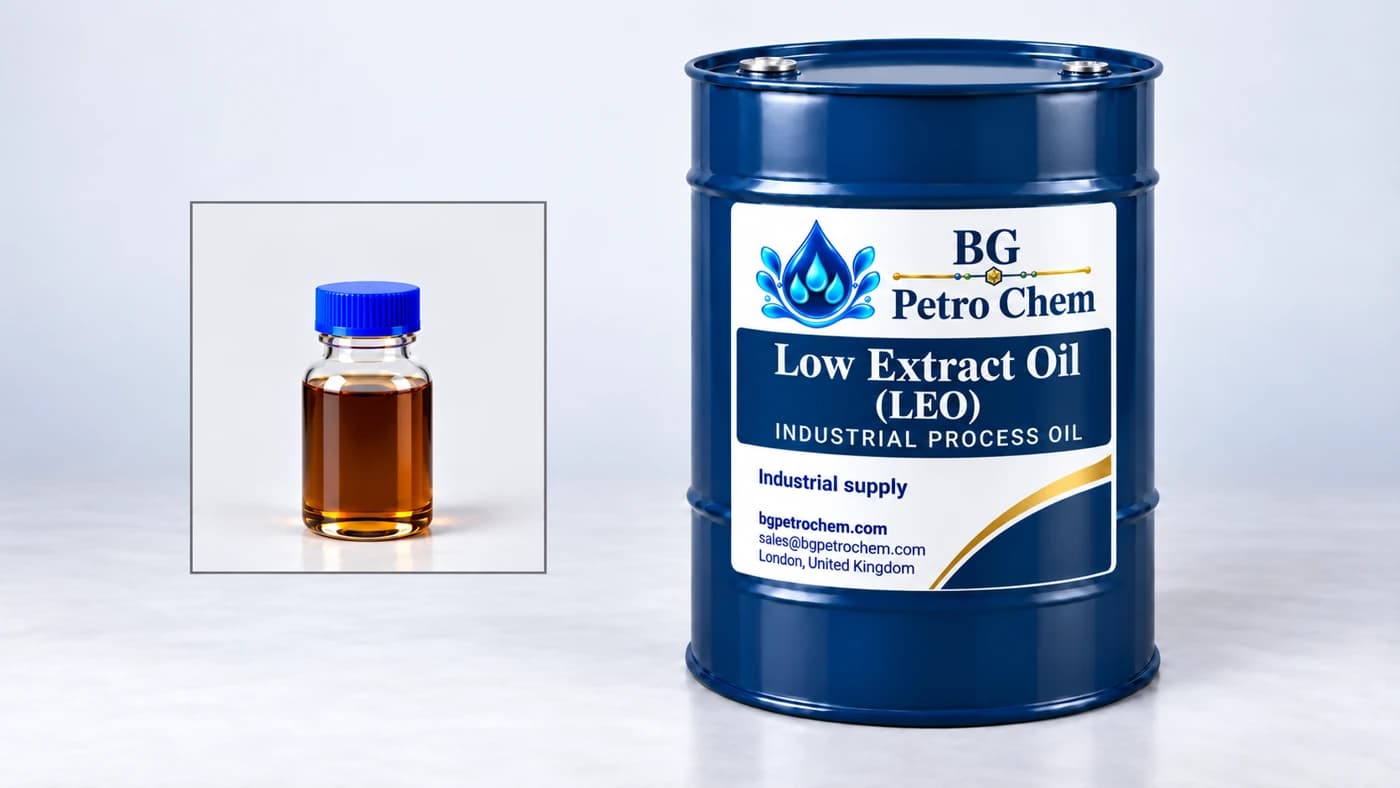
Illustrative packaging. Pack format confirmed with your quotation.
About This Product
Footwear makers working with EVA are typical buyers of Low Extract Oil, adding it to soles and midsoles as a softener and extender. Sealant and mastic producers, formulators of rubber-based adhesives and putties, and processors of lighter polymer goods use it too, wherever a low-viscosity oil handles better than a heavy extract. Buyers who need to extend or reclaim rubber generally move up to High Extract Oil, the heavier and more aromatic grade, and tyre compounders use the dense Rubber Process Oil.
The specification sets a kinematic viscosity floor of 2.5 cSt at 100 °C, against 12.0 cSt for HEO, with no upper limit, and it is that low floor that places LEO at the thin end of the extract range. That thinness is what buyers pay for. The oil can be moved and dispersed at modest temperatures, coats fillers fast and brings a compound to the required softness without lengthy mixing. Specific gravity does not exceed 1.10.
Treat the flash point with care. Its COC minimum of 150 °C is shared with HEO, yet RPO is held to at least 204 °C and Carbon Black Feedstock Oil to at least 240 °C. Check the figure against the temperatures your mixing, calendering and curing steps reach, and keep the mixer under good temperature control with effective fume extraction.
Two further limits are typical of an extract. Sulphur can be as high as 5.6 wt %, since solvent extraction pulls the distillate's sulphur-containing aromatics into this fraction, and Conradson carbon residue, a measure of what turns to coke on strong heating, can reach 10.0 wt %. Neither usually decides suitability for compounding; both carry more weight if the oil is to be burned or kept at high temperature. Because there is no colour limit, trial a small batch first if the finished article is light in colour.
LEO originates in lube refining. Solvent extraction separates a lube distillate into raffinate, the stream that becomes base oil, and an extract carrying the aromatic and polar species. When that extract comes from the lighter distillates it is thin and free-flowing and has strong solvency. HEO is chemically similar; the real distinction is viscosity, which governs how each oil processes and how it performs in the end product. Indicative supply is 700 – 1,500 MT per month. The SDS gives the classification of this aromatic extract and the precautions for safe use.
LEO of Pakistan origin is supplied by BG Petro Chemicals in drums, IBC tanks or ISO tanks, and custom packaging can be arranged. A certificate of analysis is issued for each lot, and the technical datasheet and SDS are available on request.
Specifications
Applications
Packaging Options
- Drums
- IBC tanks
- ISO tanks
- Custom packaging