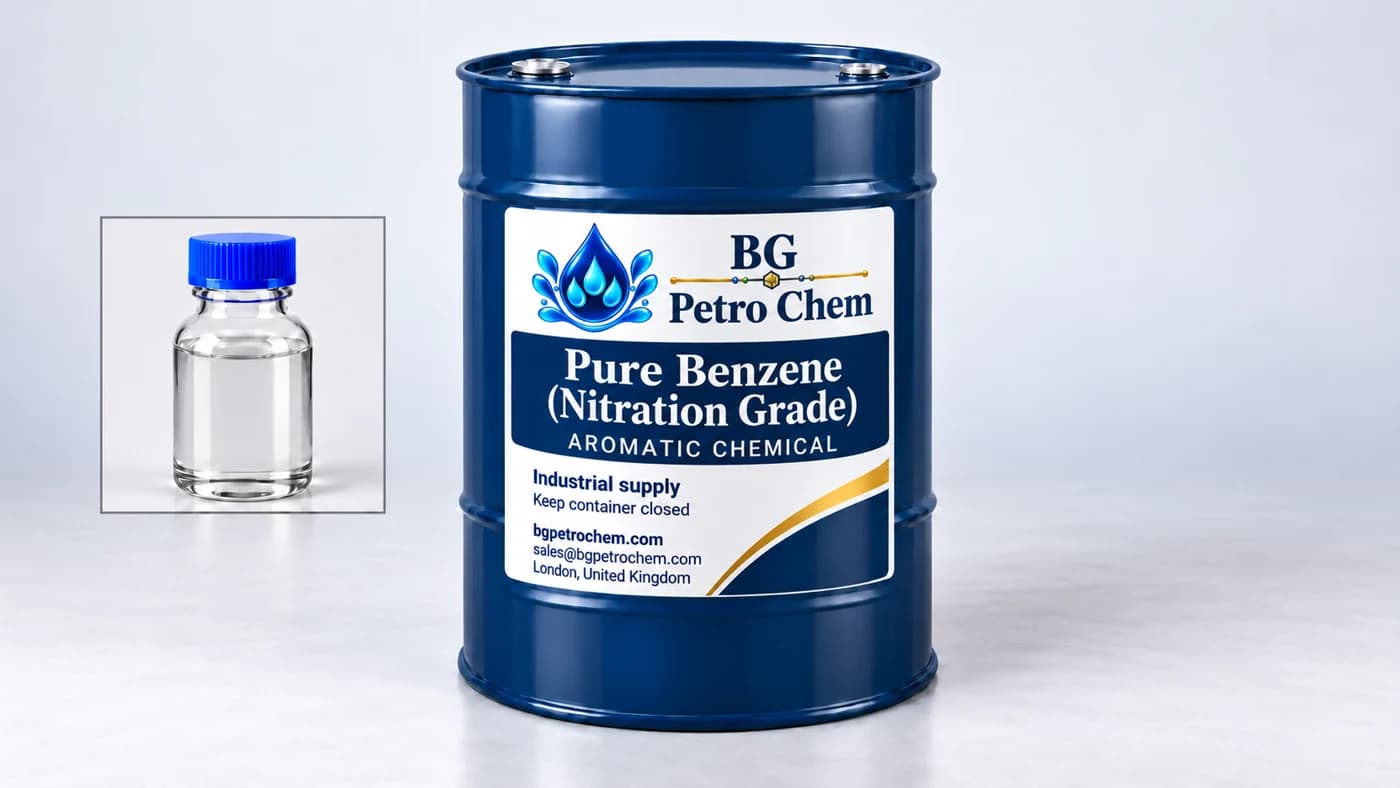
Illustrative packaging. Pack format confirmed with your quotation.
About This Product
This grade is produced in a refinery aromatics complex built around a catalytic reformer. Over a platinum catalyst, naphthenes in the naphtha feed lose hydrogen and paraffins close into rings; a selective solvent then pulls the aromatics out of the unconverted paraffins, and the extract is fractionated, with benzene taking the lightest of the three BTX cuts. Unlike toluene and xylenes, it is bought almost entirely for chemical conversion rather than as a solvent.
For a plant buyer the first purity check is the solidification point. Any co-boiling paraffin or trace of toluene depresses it, so a minimum of 4.85 °C on an anhydrous basis (ASTM D-852) is a sensitive indicator of how clean the material is. Boiling within a 1°C window that includes 80.1°C (ASTM D-850) shows that the liquid distils as one component. Specific gravity at 15.56/15.56°C (ASTM D-3505), set at 0.8820 – 0.8860, offers a quick contamination check on receipt.
The nitration grade tests are the ones that protect a mixed-acid nitrator and the catalysts further downstream. Acid wash colour is held at max 2, restricting olefinic and thiophenic species, which react with concentrated sulphuric acid to give dark, tarry by-products. Acidity is nil, the sulphur compounds test shows the product free of H2S & SO2, and copper strip corrosion is rated non-corrosive, so alkylation and hydrogenation catalysts and carbon-steel equipment are not attacked. Pt-Co colour is max 20, which is essentially water-white.
Most benzene is chemically converted rather than used as supplied. Alkylation with ethylene gives ethylbenzene, the precursor of styrene; with propylene, cumene, which goes on to phenol and acetone; and with long-chain olefins, linear alkyl benzene, the base of detergent surfactants. Hydrogenation yields cyclohexane for caprolactam and nylon, and nitration yields nitrobenzene for aniline and MDI. Toluene and mixed xylenes, drawn from the same extraction unit, find their main markets as solvents and intermediates instead. Benzene is classified as a known human carcinogen and belongs only in plants with strict industrial controls: closed transfer, vapour control and monitoring of exposure, with the classification and handling requirements given in the SDS. It freezes at a comparatively high temperature, so heated tanks and lines may be needed in winter.
BG Petro Chemicals offers benzene of Pakistani origin. Packaging and the mode of transport are agreed offer by offer and follow the carriage rules for flammable liquids. Each consignment is accompanied by its certificate of analysis, and the SDS is available on request.