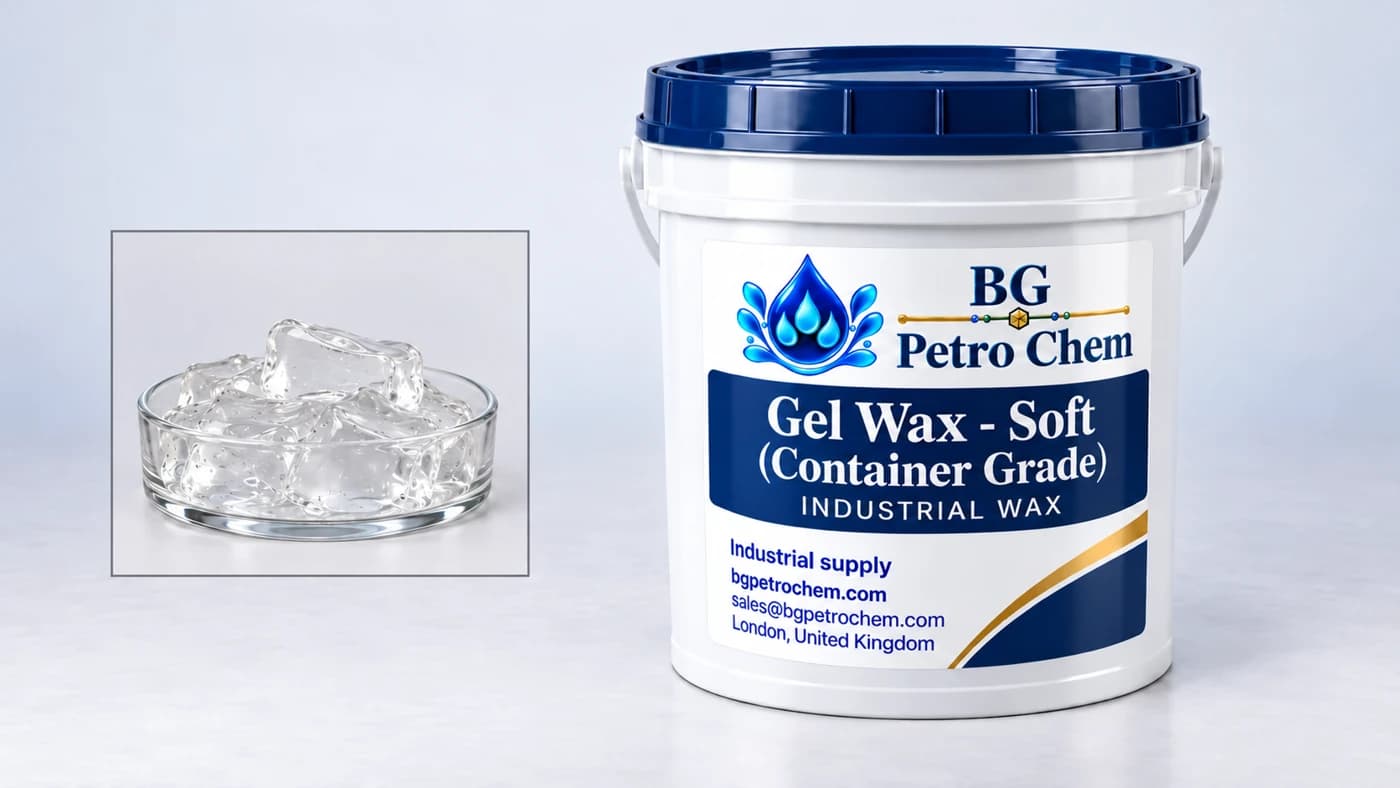
Illustrative packaging. Pack format confirmed with your quotation.
About This Product
Two components make up soft gel wax: white mineral oil, CAS 8042-47-5, and a styrenic block copolymer, CAS 25034-86-0. Compared with the moulded grades it contains less polymer. Supplied as transparent jelly blocks, it has a maximum heating temperature of 110–120 °C, a suggested pour temperature of 85–95 °C and a suggested fragrance load of 3–5%.
That lighter polymer dose is what suits it to containers. The molten gel is thinner, so it reaches into the corners of a jar, wets the glass completely and gives entrained air time to rise and escape before setting, which decides whether the finished candle is crystal clear or full of bubbles. The price is a soft, slightly tacky gel that would sag if taken out of a mould, so it stays in, and is burned in, the glass it was filled into. Low viscosity also lets embeds wander or sink while the gel is still liquid; fix them to the bottom of the vessel instead of relying on the gel to suspend them. Fragrances must have been tested as gel-compatible, and only heat-resistant glass should be used, because a gel candle runs hotter than a standard wax candle.
Retail craft kits, hospitality and event candles, aquarium and scene designs and gel candles in jars and containers are the usual products. BG Petro Chemicals supplies this grade to agreed values for clarity, viscosity, polymer content, fragrance compatibility and flash point.