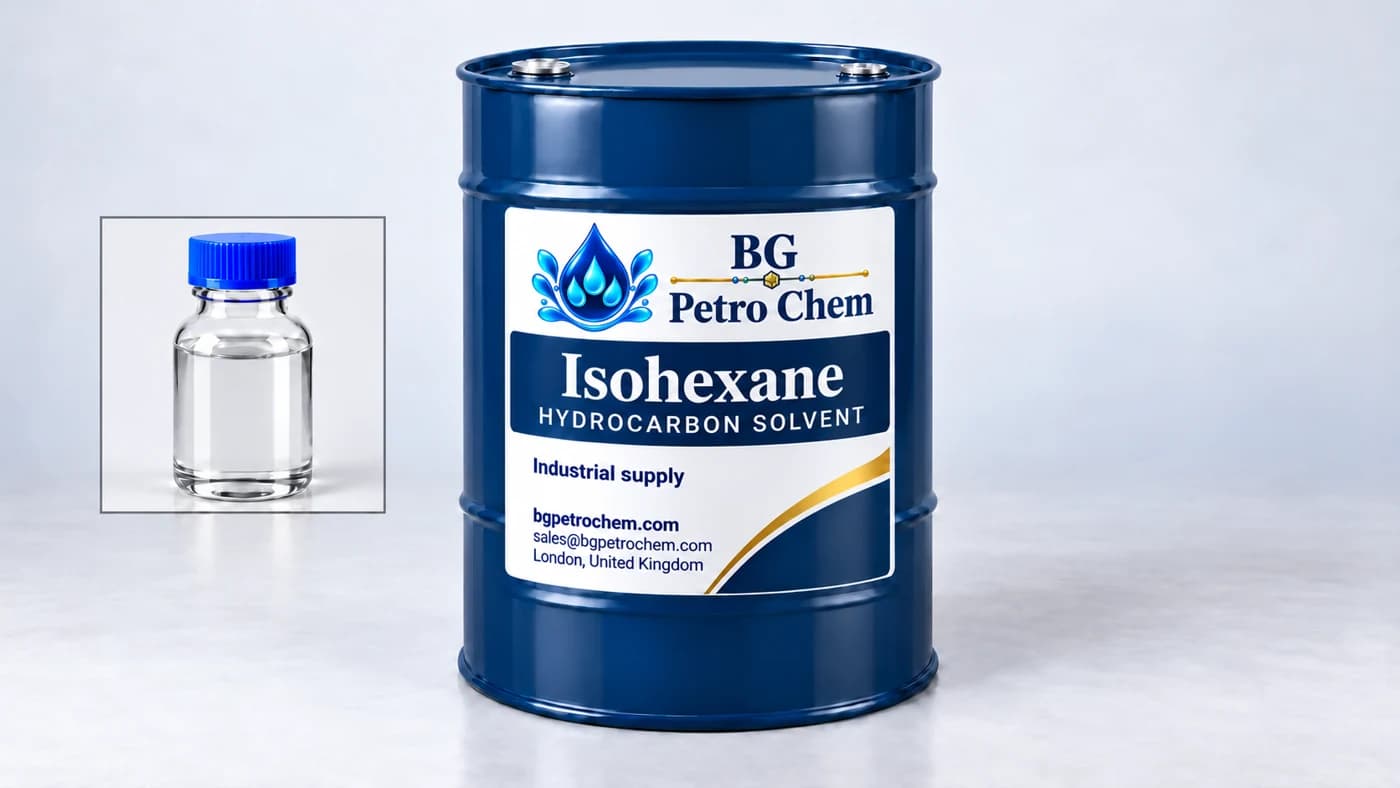
Illustrative packaging. Pack format confirmed with your quotation.
About This Product
Adhesive makers, cleaning formulators and extraction plants that must eliminate n-hexane exposure usually turn to isohexane. The linear isomer is converted in the body to 2,5-hexanedione, a metabolite that harms the peripheral nervous system, whereas the branched isomers dissolve and evaporate in much the same way without that metabolic pathway.
In trade usage the name covers the branched hexanes (C6H14), principally 2-methylpentane, CAS 107-83-5, plus 3-methylpentane. This is a clear, colourless and very volatile liquid with a boiling range of roughly 57 to 62 °C; it is immiscible with water and readily takes up oils, rubbers and non-polar resins.
Total isohexane is 98 percent minimum, typically 99, while n-hexane may not exceed 1.5 percent; the isomer split is reported, with 2-methylpentane typically near 65 percent and 3-methylpentane near 23. Trace limits are tight: benzene 0.0001 percent (1 ppm), sulphur 1 mg/kg and bromine index 100 mg Br/100 g, low enough for polymerisation duty, where impurities could poison the catalyst. Water (100 mg/kg max), density (650–669 kg/m³ at 20 °C), Saybolt colour (30 min) and non-volatile matter (1 mg/100 ml max) are also controlled, and the product must be clear, without precipitates or turbidity.
Its outlets include polymerisation, contact and rubber adhesives, cleaning of precision parts and instruments, dilution of oils, gas chromatography reference work and use as a fuel component.
BG Petro Chemicals supplies isohexane in 130 kg drums or ISO tanks under UN 1208, Class 3, PG II. Being highly flammable and an aspiration hazard, it should be handled to the safety data sheet; current specifications, the SDS and available batch documentation can be requested.
Specifications
Applications
Packaging Options
- 130 kg drum
- ISO tank
Supply notes
- Product documentation
- Contact our team for current specifications, safety data and available batch documentation.