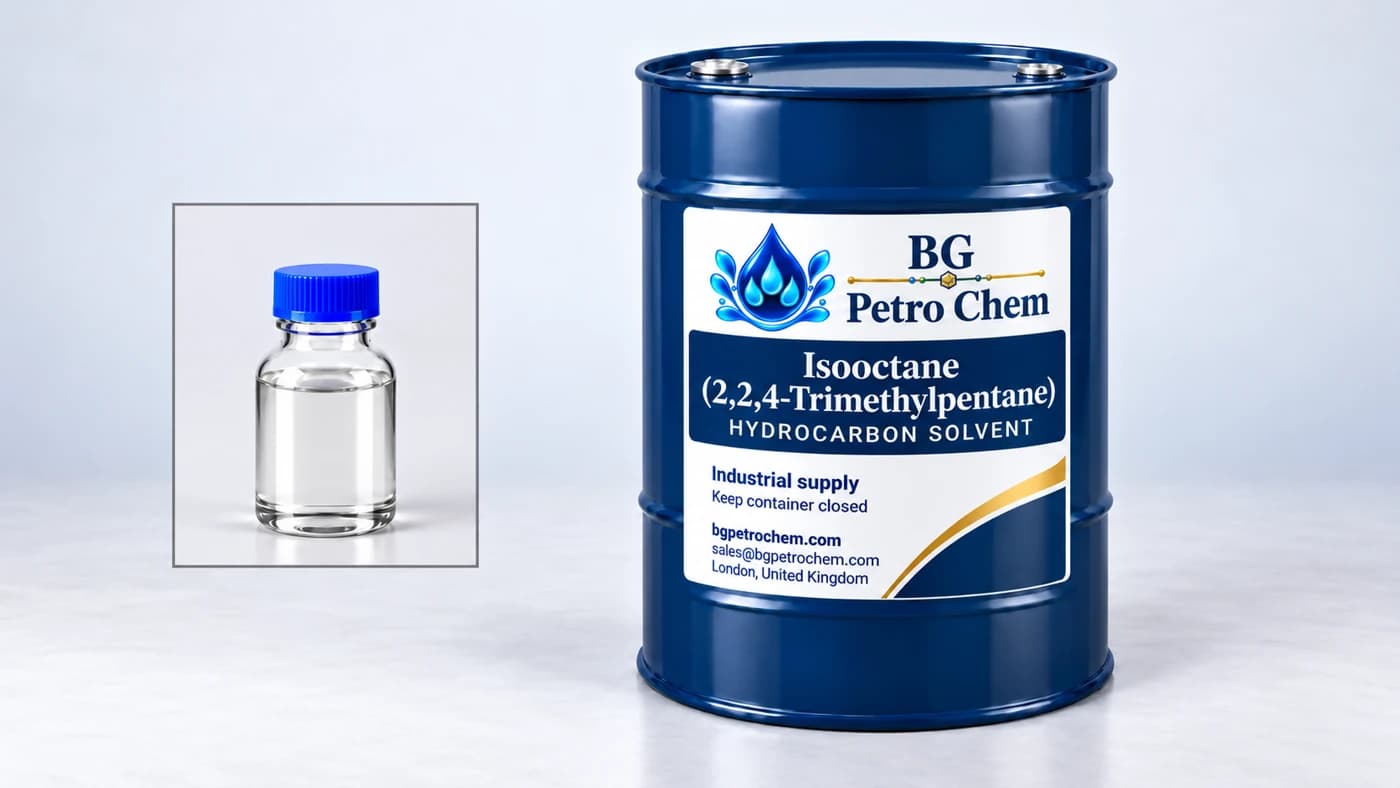
Illustrative packaging. Pack format confirmed with your quotation.
About This Product
Isooctane, properly 2,2,4-trimethylpentane (C8H18, CAS 540-84-1), is a C8 paraffin with a heavily branched skeleton. The clear, colourless liquid boils near 99 °C, does not dissolve in water and blends in all proportions with other hydrocarbons.
That branching makes it extremely reluctant to autoignite, and it was therefore given the value 100 on the octane scale, n-heptane being zero. Since every octane number is measured against blends of these two, engine and fuel laboratories depend on reference material whose purity cannot be in doubt. Being unreactive and transparent in the ultraviolet, isooctane is also a standard analytical solvent, written into fats and oils methods such as the acetic acid–isooctane peroxide value test and the anisidine value test.
The 99.9 percent grade carries 99 wt% minimum of 2,2,4-trimethylpentane (typically 99.9) and 99 wt% minimum of isooctane (C8). Its limits are: light components (C6 and below) 0.0150 wt%, aromatic hydrocarbons 0.0200 wt%, bromine index 5 mg Br/100 g, sulphur 5 ppm, water 50 ppm and non-volatile matter 1 mg/100 g. Distillation runs from 96 °C minimum to 107 °C maximum; the aniline point is 77–80 °C and density 0.69–0.70 g/cm³.
Beyond octane reference fuels, it is used for spectroscopic and other analytical work, in fats and oils testing, as a non-polar solvent and extractant, and as a synthesis raw material.
BG Petro Chemicals supplies it in 142 kg drums or ISO tanks under UN 1262, Class 3, PG II. The product is highly flammable and poses an aspiration hazard, so handle it to the safety data sheet; current specifications, the SDS and batch documentation are available on request.
Specifications
Applications
Packaging Options
- 142 kg drum
- ISO tank
Supply notes
- Product documentation
- Contact our team for current specifications, safety data and available batch documentation.