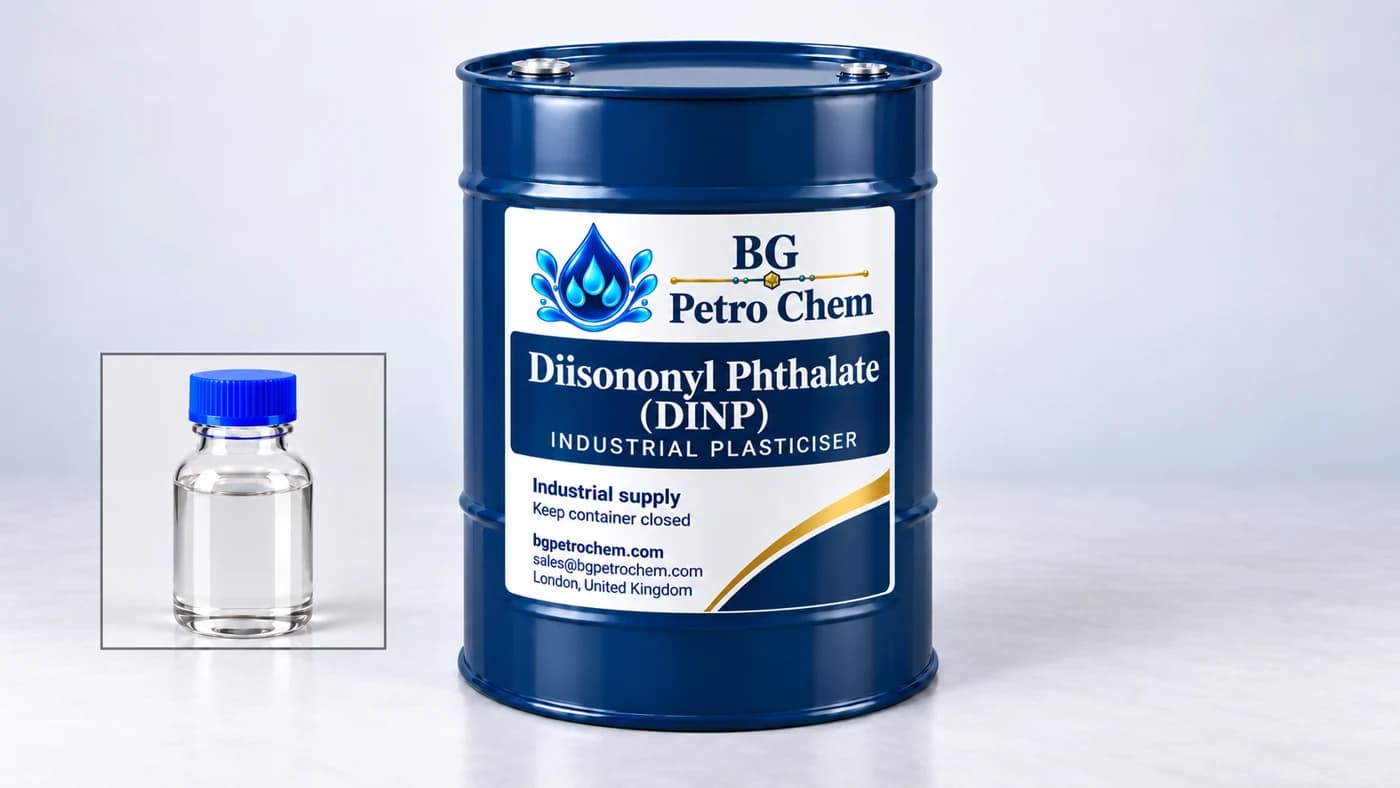
Illustrative packaging. Pack format confirmed with your quotation.
About This Product
DINP serves flexible PVC as a general-purpose plasticiser. Typical end products are flooring and wall coverings, wire and cable compounds, calendered film and sheet, synthetic leather and coated fabrics, hoses, profiles and gaskets, roofing membranes, and the plastisols applied to car interiors and underbodies. For spread coating, dipping and rotational moulding, plastisol makers find that its viscosity and the way it fuses work well, and certain sealants and adhesives use it as their plasticiser too.
Regulation decides where it can go. Under entry 52 of Annex XVII to EU REACH, and the equivalent UK REACH entry, toys and childcare articles that children can put in their mouths may contain no more than 0.1% DINP by weight, so it is kept out of them. Its CLP classification and any Candidate List status have both been under review: take the current position from the latest safety data sheet, and confirm the food-contact rules for your market. Importers into the EU or Great Britain should establish which registration covers their import and use. Where the rules allow it, few plasticisers are used more widely, because it is easy to process, fuses readily in plastisols and gives good value for the performance it delivers.
It is made by esterifying phthalic anhydride with isononanol. Isononanol is itself a mixture of branched C9 alcohols, so DINP is a blend of isomers, with an approximate formula of C26H42O4, not one defined molecule; according to the alcohol route used, it trades under CAS 28553-12-0 or CAS 68515-48-0. In the drum it is an oily liquid, clear, practically colourless and of low volatility. Set against DEHP, its longer alkyl chains reduce volatility and make it harder to extract from the finished article. The trade-off is slightly lower plasticising efficiency, so a formulation needs a little more of it to reach a given hardness. DOTP, a terephthalate, and DINCH, a hydrogenated equivalent, are the alternatives it is usually weighed against.
A typical specification sets ester content at 99.5% minimum, Pt-Co colour at 30 maximum, acid value at 0.07 mg KOH/g maximum, water at 0.1% maximum, density at 20 °C within 0.971–0.977 g/cm³ and open-cup flash point at 210 °C minimum. Cable compounders normally add a volume resistivity limit, and plastisol users may add one for viscosity. Compare the certificate of analysis for every batch with the limits agreed.
DINP is stable under normal conditions, although long periods of contact with heat and air will raise its colour and acidity. Store it dry, in closed drums, IBCs or tanks, away from strong oxidisers; mild steel and stainless steel are both suitable materials for storage. Transport rules generally do not class it as dangerous goods; confirm this in section 14 of the safety data sheet.
For a BG Petro Chemicals quotation, tell us what the DINP is for and which market it will reach, with any restrictions that market imposes; the ester content, colour and acid value you require, plus any cable or plastisol specification; your preferred pack; your expected annual volume; and the delivery destination.
Specifications
Applications
Packaging Options
- Pack size confirmed on enquiry