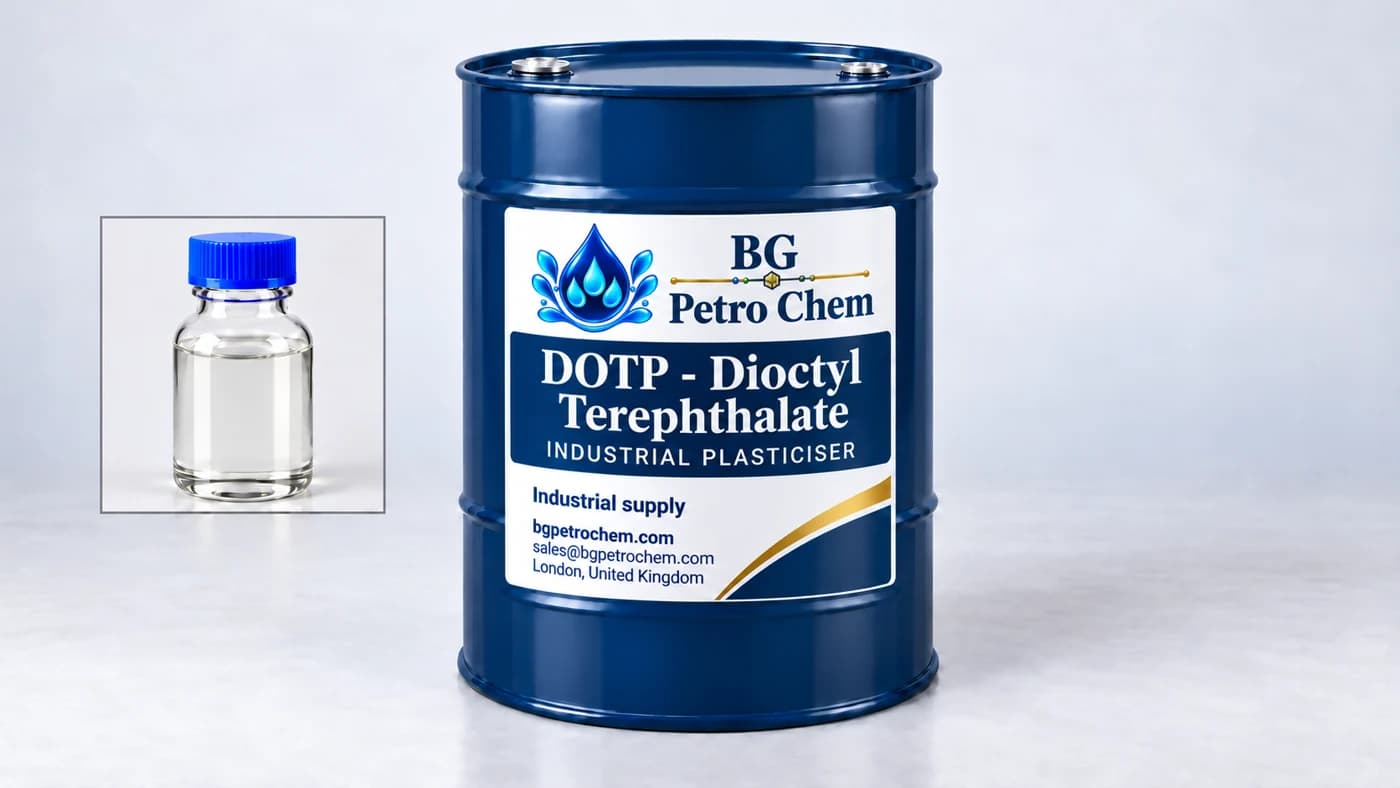
Illustrative packaging. Pack format confirmed with your quotation.
About This Product
Dioctyl terephthalate (DOTP), also called bis(2-ethylhexyl) terephthalate or DEHT, is a general-purpose PVC plasticiser with CAS number 6422-86-2 and molecular formula C24H38O4. It is produced either by direct esterification of terephthalic acid with 2-ethylhexanol or by transesterification of dimethyl terephthalate. The product is an oily, clear and practically colourless liquid with low volatility and a high flash point, typically 210 °C minimum by open cup.
DOTP has the same empirical formula as DEHP, the ortho-phthalate commonly traded as DOP. What separates them is ring position: in DOTP the two ester groups sit on opposite sides of the benzene ring, whereas in DEHP they are adjacent. Because DOTP is not an ortho-phthalate, it falls outside the restrictions and authorisation requirements that EU REACH and UK REACH impose on several ortho-phthalates, and compounders have adopted it as the principal substitute for DEHP in flexible PVC. Its plasticising efficiency is slightly lower, so a little more is needed to reach the same hardness. In return it gives lower volatility, better flexibility at low temperature and good electrical properties.
Cable makers use it in wire and cable insulation and sheathing, where volume resistivity and low volatility are critical. Other outlets include flooring and wall coverings, calendered film and sheet, coated fabrics and synthetic leather, hoses and profiles, and plastisols for coating and moulding. It is also chosen for toys and childcare articles that fall under ortho-phthalate restrictions, and acts as a non-reactive plasticiser in some adhesives, sealants and coatings.
A purchase specification normally covers ester content (typically 99.5% minimum), Pt-Co colour (typically 30 maximum), acid value (typically 0.02–0.05 mg KOH/g maximum), water (typically 0.05% maximum), density at 20 °C (typically 0.981–0.985 g/cm³) and flash point. Cable grades often carry an extra volume resistivity limit, and film grades may include a heat-loss or volatility test. Agree the tests in advance and compare each batch's certificate of analysis with the agreed limits.
Under CLP, DOTP is generally not classified as hazardous, and it is not regulated as dangerous goods for transport. Confirm both points in sections 2 and 14 of the safety data sheet for the material actually offered. The substance is registered under EU REACH. Importers into the EU or Great Britain should establish which registration covers their import and use, and ask for a current Candidate List statement. For toys or food-contact articles, request a declaration of compliance with the rules that govern the finished article.
Keep it in closed drums, IBCs or tanks, in a dry place and away from strong oxidising agents. It is stable under normal storage, but prolonged heating in contact with air can gradually raise colour and acidity. Mild steel and stainless steel are suitable tank materials. Avoid extended contact with certain rubbers and plastics, which DOTP can swell.
To obtain a quotation from BG Petro Chemicals, give the application and grade (general purpose or cable), your limits for ester content, colour and acid value, any resistivity or volatility test required, the pack you want (drum, IBC, flexitank or ISO tank), annual volume and destination.