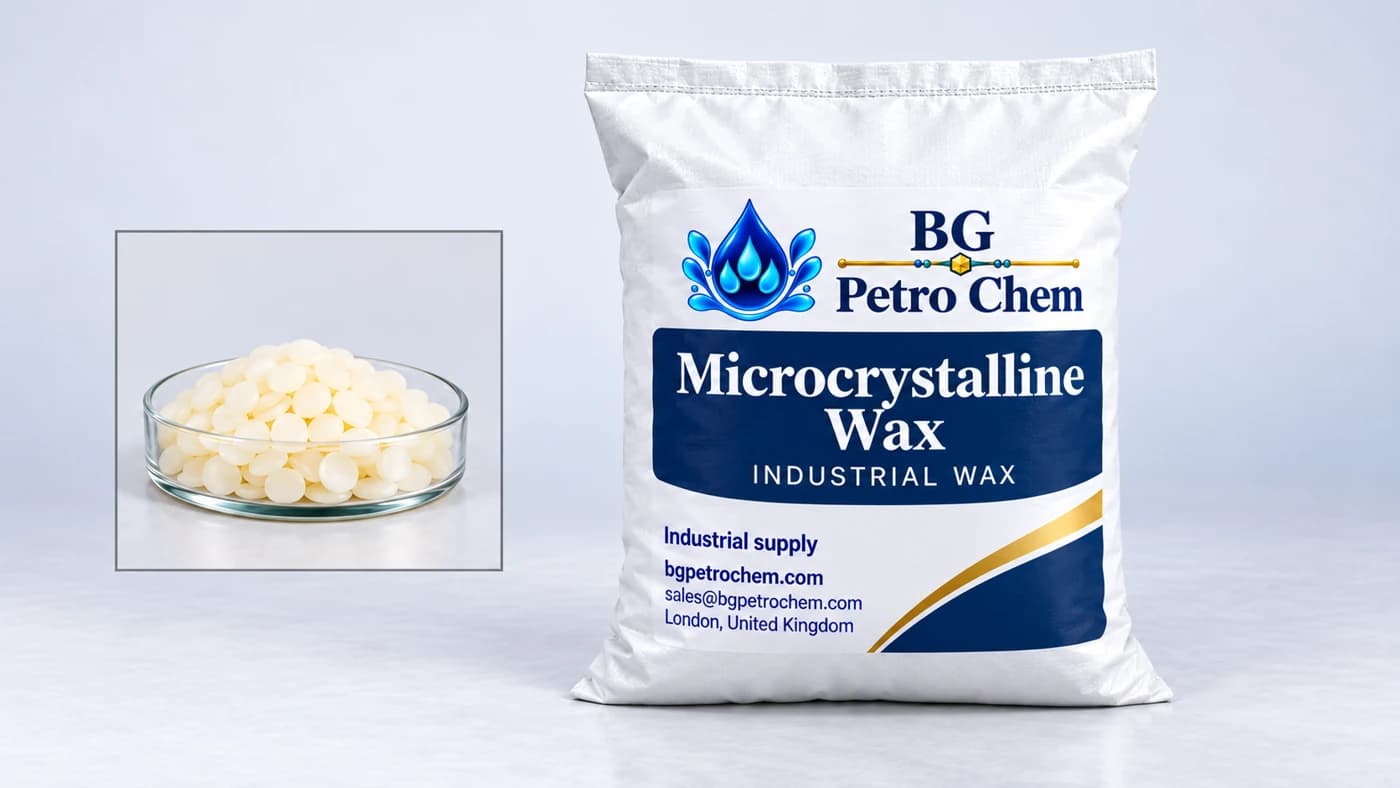
Illustrative packaging. Pack format confirmed with your quotation.
About This Product
Microcrystalline wax (CAS 63231-60-7) is a product of the heavy residual end of crude oil refining, whereas paraffin comes from distillate streams. Its melting point varies with grade, usually somewhere between 60 and 93 °C, and slabs and pastilles are available in colours running from white to amber.
Molecular shape explains how it behaves. Paraffin's straight-chain alkanes line up into big, regular plate crystals, giving a wax that is hard and glossy but brittle. Microcrystalline wax consists instead of heavier isoparaffins (branched) and naphthenes (cyclic), whose irregular shapes cannot settle into an ordered lattice. Only very small crystals form, hence the name, and the result is a flexible, tough, tacky wax that holds far more oil than paraffin.
Those properties are what blenders use it for. Added to candle wax it prevents larger pieces from cracking, helps the candle grip glass and mould walls, stops fragrance and colour from migrating and raises the melting point of the blend. Grades fall into two broad families: softer, tackier laminating grades and higher-melting hardening grades.
Other uses include adhesives and laminating, tyre and rubber compounding, cosmetics and creams, casting and corrosion protection. BG Petro Chemicals supplies microcrystalline grades to agreed limits on needle penetration, melting point, viscosity, oil content and colour.