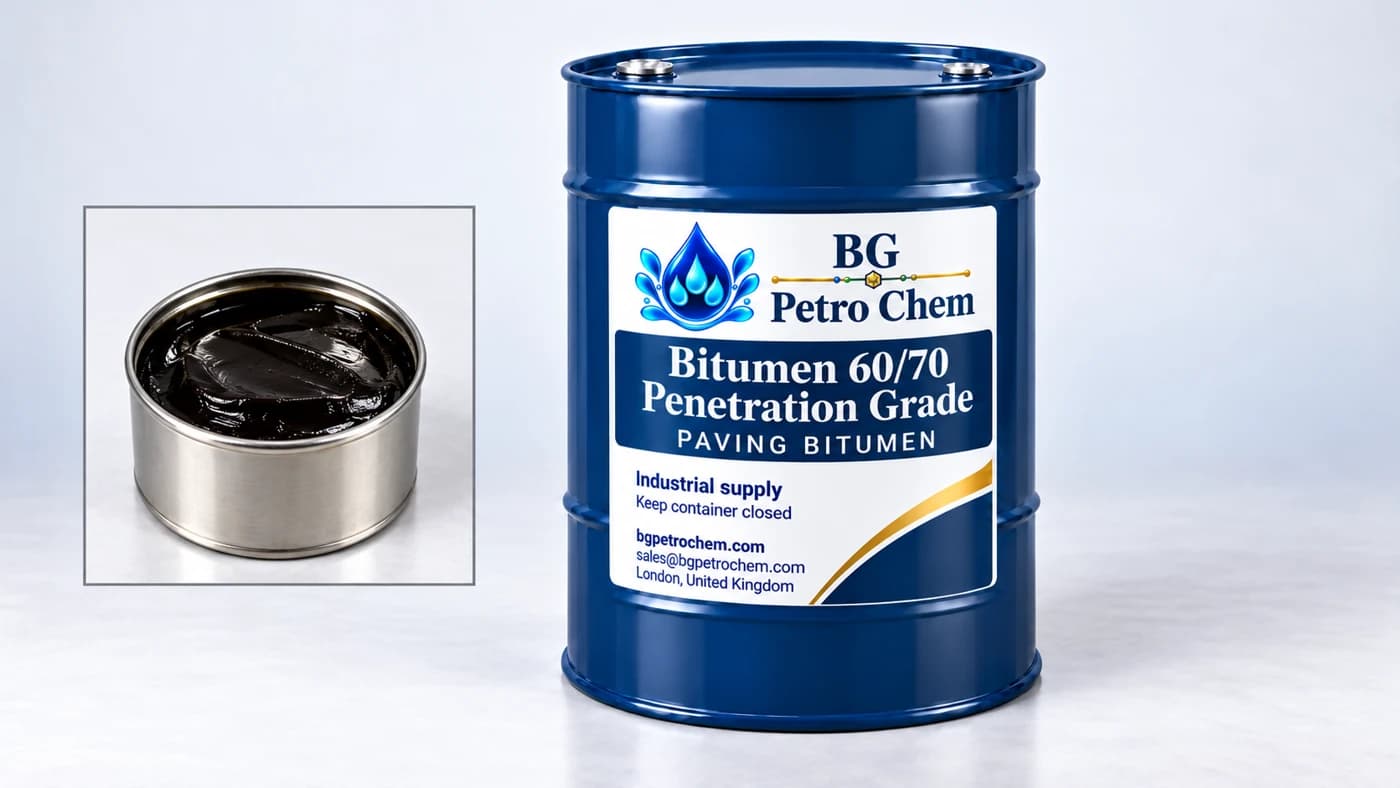
Illustrative packaging. Pack format confirmed with your quotation.
About This Product
Asphalt producers in warm and hot regions reach for 60/70 more often than for most other paving binders. Typical work includes surface, binder and base layers of asphalt concrete for highways and city streets, together with runways, taxiways and aprons on airfields. The grade is also taken as feedstock bitumen for emulsion and cutback manufacture and for polymer modification. Grade selection usually rests with the road authority, which weighs local climate against expected traffic and moves to softer grades where conditions are cooler or loads lighter.
Penetration, the property behind the name, is measured under ASTM D-5: a needle carrying a 100 g load rests on the sample at 25 °C for 5 seconds, and its depth of travel is recorded in units of 0.1 mm. Results of 60 – 70 put this binder in the moderately hard class. Under slow-moving heavy vehicles in summer it holds its shape against rutting, while still coating aggregate and compacting well at plant and paver. Softening point by ring and ball (ASTM D-36) lies between 45 and 51 °C; paired with penetration, this figure tells the mix designer how strongly the binder responds to changes in temperature.
Ductility at 25 °C, pulled at 5 cm/min under ASTM D-113, must reach at least 100 cm, a measure of cohesion that points to good crack resistance. Plant ageing is checked by heating the sample for 5 h at 163 °C (ASTM D-6). Mass loss is capped at 0.2 wt %, and penetration afterwards must be no lower than 75 % of the original value, giving assurance that the binder will not turn brittle during hot mixing. With at least 99 wt % soluble in trichloroethylene (ASTM D-2042), the product is essentially pure bitumen with negligible insoluble matter. Flash point by Cleveland open cup (ASTM D-92) is at least 232 °C, comfortably above usual storage and mixing temperatures, and specific gravity at 25/25 °C (ASTM D-70) is 1.01 – 1.06.
The binder itself is the bottom product of crude oil refining. Atmospheric distillation followed by vacuum distillation removes the fuel and lubricant cuts, and the residue left behind is a black viscoelastic material: asphaltenes held in a medium of resins together with aromatic and saturated oils. Refiners control its hardness mainly through the crude they select and how deeply they run the vacuum unit, occasionally finishing with light air blowing.
Material is of Pakistani origin, with up to 15,000 MT available each month. BG Petro Chemicals delivers in bulk, in drums or in ISO tanks and can arrange project-specific packaging. A certificate of analysis is issued for every lot; the TDS and the SDS, which covers safe handling of hot product, can be supplied on request.
Specifications
Applications
Packaging Options
- Bulk
- Drums
- ISO tanks
- Custom packaging