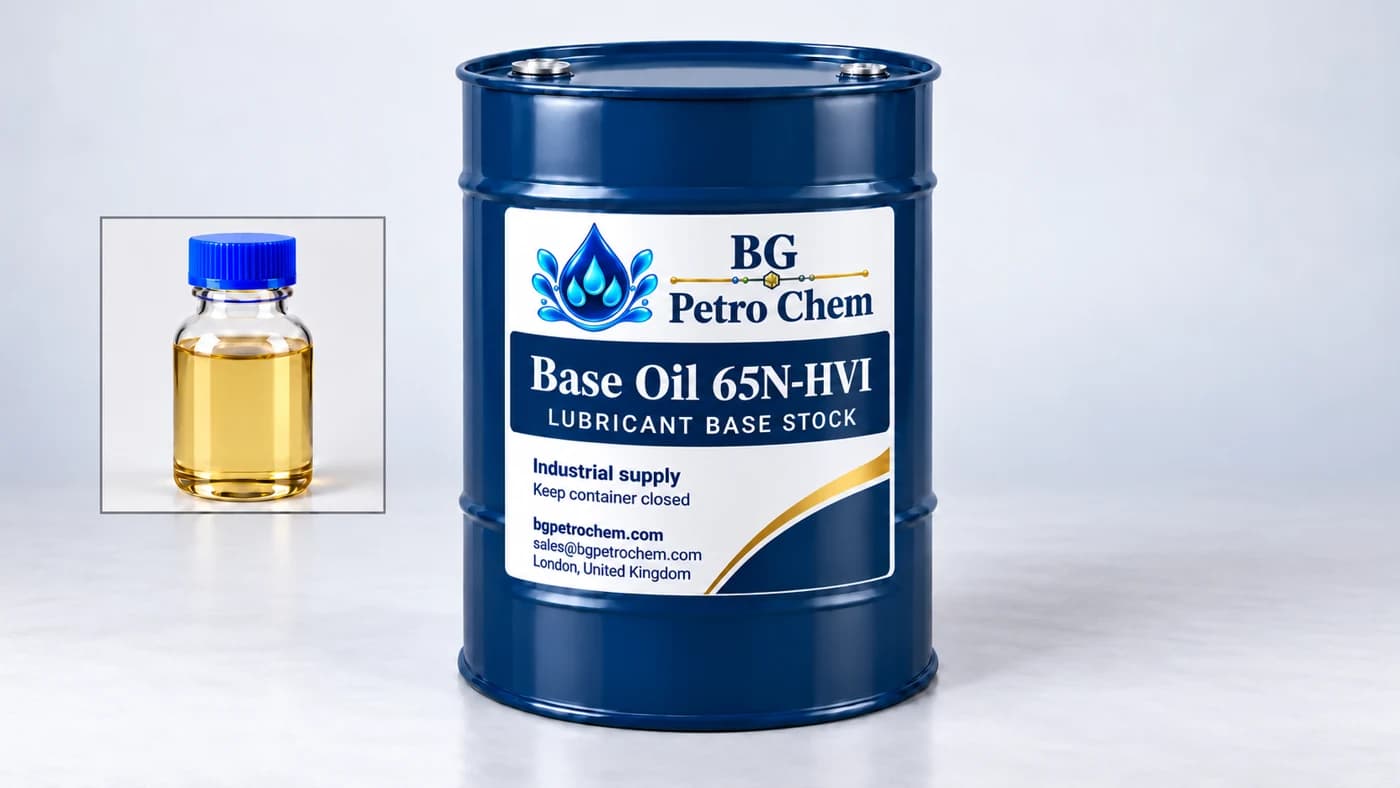
Illustrative packaging. Pack format confirmed with your quotation.
About This Product
In a shock absorber, damping force depends directly on how viscous the fluid is, so a damper oil needs a base stock whose viscosity changes as little as possible between a frosty start and a hot, hard-working unit. Base Oil 65N-HVI is made for that kind of duty. Formulators also use it in instrument oils and lubricants for precision mechanisms, in low-viscosity hydraulic fluids and in rust preventives. Lubricant blending plants keep a tank of it as a correction stock, since a modest dose will bring an over-viscous batch back into specification.
The viscosity window of 10.0 – 12.0 cSt at 40 °C is narrow, so a blender can reach a target in one pass rather than through several adjustments. Achieving a viscosity index of at least 95 in such a light cut is more difficult than in the heavier neutrals; the reward is an oil that loses less viscosity on heating and gains less on cooling than a naphthenic stock of comparable grade. No other numbered neutral in the range has a pour point as low as this one, max -9 °C. Flash point is quoted as min 130 °C by Pensky-Martens closed cup (ASTM D-93), the more cautious method and the one that governs storage classification. Low limits on carbon residue (max 0.04 wt %), colour (ASTM max 1.5) and acidity (max 0.05 mg KOH/g) keep the stock clean and close to neutral when it enters a formulation.
All the numbered neutrals are paraffinic distillates, and the 65N comes from the lightest side draw of the vacuum column, where heavy atmospheric residue is split by boiling range. Solvent extraction takes out the aromatic compounds responsible for steep viscosity–temperature behaviour, dewaxing removes paraffins that would otherwise crystallise at low temperature, and a final finishing stage fixes colour and stability.
For passenger car motor oils and general hydraulic duty, the next grade up, the 100N-HVI, is usually the better fit. Spindle Oil and Transformer Base Oil cover much the same viscosity territory, but those two are specified for particular end products: spindle lubrication and the manufacture of insulating oils. The 65N-HVI, by contrast, is a general blending component with a narrower viscosity range and a carbon residue limit that neither of the others carries.
Supply is of Pakistan origin, indicatively 1,000 – 2,500 MT per month. Shipments can be made as bulk cargo, in ISO tanks or flexi bags, or for smaller customers in IBC tanks and drums, and BG Petro Chemicals can also arrange custom packaging. Each lot comes with a certificate of analysis, and the TDS and SDS are available on request.
Specifications
Applications
Packaging Options
- Bulk
- Drums
- Flexi bags
- IBC tanks
- ISO tanks
- Custom packaging